AI Website Development: How Good Has It Really Gotten?
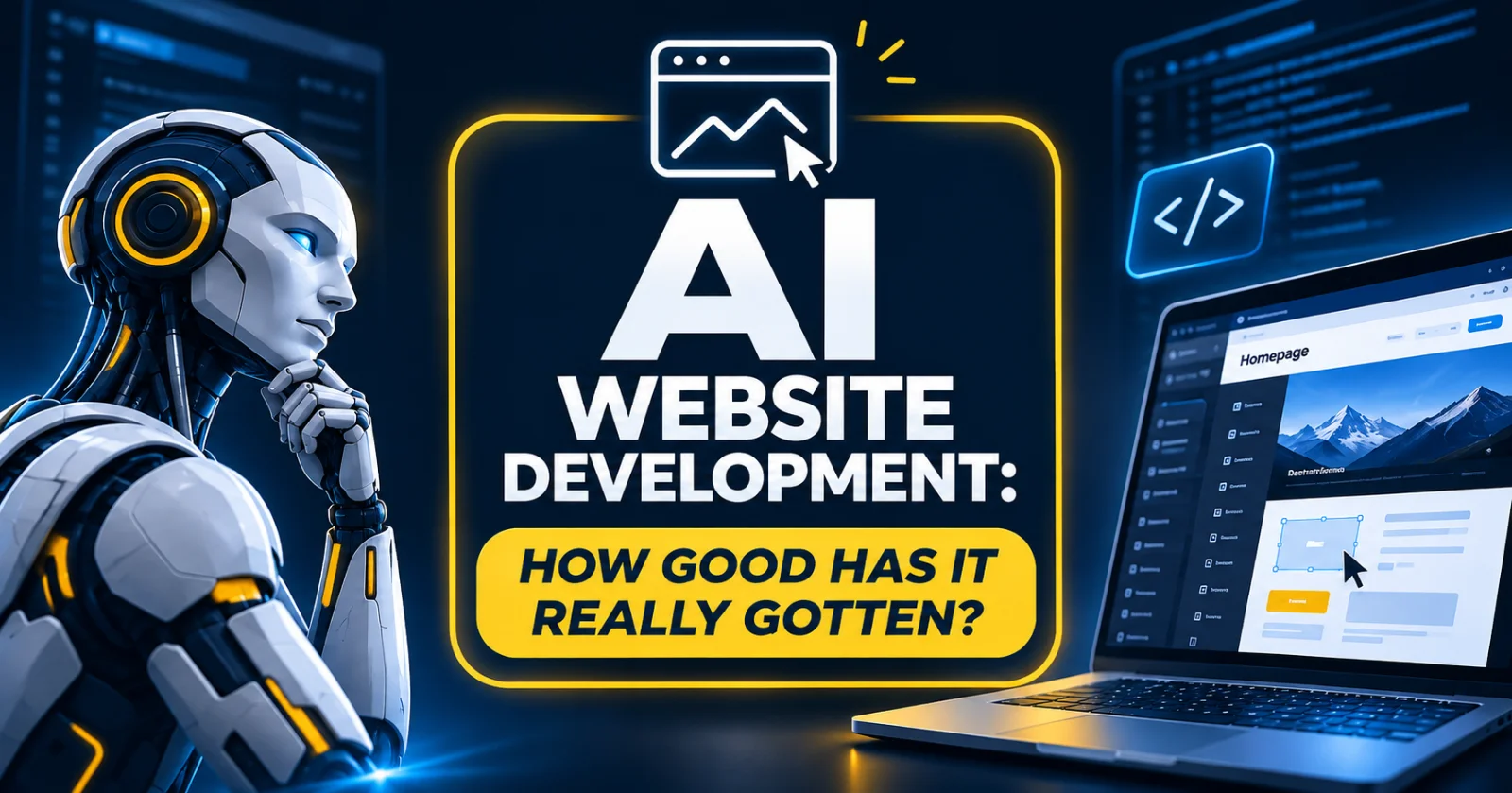
AI website development has moved from a gimmick to a genuinely useful toolset. Today's AI builders can generate layouts, copy, and code quickly, but they still fall short on strategy, conversion design, and ongoing optimisation, which is why most small businesses pair AI tools with human oversight.
Key takeaways
- AI website development tools can now generate full page layouts, copy, and basic code in minutes, drastically cutting first-draft time.
- AI is strongest at speeding up production work wireframes, copy drafts, image generation not at strategic decisions like conversion architecture or brand positioning.
- Quality still depends heavily on the prompts and business context you feed the AI; generic inputs produce generic sites.
- AI-built sites often need a human pass for SEO structure, accessibility, mobile performance, and brand consistency before launch.
- The most effective approach for small businesses is a hybrid: AI for speed, humans for strategy, testing, and ongoing optimisation.
Introduction
AI website development has gone from a novelty feature to a serious part of how small business sites get built. A few years ago, "AI website builder" mostly meant a glorified template picker. Today, AI tools can read a short business description and generate a working homepage — layout, copy, images, and basic code — in minutes. The real question for business owners isn't whether AI can build a website anymore. It's whether an AI-built site is actually good enough to represent your business and convert visitors into customers.
What AI Website Builders Can Actually Do Well
Modern AI tools are genuinely strong at a few specific things:
- Speed of first drafts. Instead of starting from a blank page, AI can generate a full multi-section layout with placeholder copy almost instantly.
- Copywriting assistance. AI can draft headlines, service descriptions, and calls to action based on a short prompt, giving you something to edit rather than write from scratch.
- Design consistency. Many AI builders automatically apply consistent spacing, colour palettes, and typography across pages, which used to require a trained eye.
- Code generation. For simpler sites, AI can write clean HTML/CSS or component code for common patterns like contact forms, pricing tables, and navigation menus.
- Image and asset generation. AI image tools can produce stock-style graphics or hero images without a licensing search, which is useful for filling visual gaps quickly.
For a small business that needs a basic, professional-looking site fast, this is a real improvement over where things stood even a short time ago.
Where AI Still Falls Short
AI website development is not a complete replacement for strategy and experience. Common gaps include:
- Generic messaging. Without detailed, specific input about your business, AI tends to produce copy that sounds like every other business in your industry.
- Conversion architecture. Where buttons go, how trust signals are placed, and how forms are structured to reduce drop-off these decisions come from testing and experience, not just pattern-matching.
- SEO structure. AI can write words, but proper heading hierarchy, metadata, schema markup, and internal linking still need a deliberate strategy tied to how your business actually wants to rank.
- Accuracy and compliance. AI-generated claims, pricing, or service details can be wrong or outdated if not carefully checked a real risk for regulated industries or anything involving guarantees.
- Mobile and accessibility performance. AI drafts often look fine on a desktop preview but need a human pass to confirm they load fast and work well for real visitors on phones.
Is AI Good Enough to Launch a Business Website On Its Own?
This is the question most owners actually want answered. The honest answer: AI is good enough to get you a usable starting point quickly, but not yet good enough to be the final step for a business that depends on its website for leads. Think of AI as a fast first draft generator, not a finished product. The businesses getting the best results are the ones using AI to compress the early production stages wireframes, copy drafts, image options and then having a human review pass for accuracy, SEO, and conversion optimisation before the site goes live.
This hybrid approach also tends to be more cost-effective than either extreme. Pure AI output can require expensive rework if it's not strategically sound from the start, and a fully manual build from scratch can take far longer than necessary when AI could have handled the first draft.
How to Use AI for Your Website the Right Way
If you're considering AI tools for a site refresh or a new build, a few practical guidelines help:
- Feed it specifics, not generalities. The more detail you give AI about your services, customers, and differentiators, the less generic the output.
- Treat AI output as a draft, not final copy. Every claim, price, and service description should be checked against reality before publishing.
- Have someone check SEO fundamentals. Page titles, meta descriptions, header structure, and internal links shouldn't be left to chance.
- Test on real devices. AI previews can look polished in a browser tab and still underperform on mobile load speed.
- Plan for ongoing updates. A website isn't a one-time project — AI can help you iterate faster, but someone still needs to own performance monitoring and updates over time.
If you'd rather not manage that process yourself, our website management services combine AI-assisted production speed with human strategy, SEO structure, and ongoing optimisation, so your site stays accurate and effective long after launch.
The Bottom Line
AI website development has genuinely improved and is now a legitimate tool for speeding up the early stages of building a site. It is not yet a substitute for strategic design, accurate content, and SEO discipline. For most small businesses, the smartest move is using AI to move faster through the first draft, then relying on experienced oversight to make sure the final site actually performs-loading quickly, ranking well, and turning visitors into customers.
Frequently asked questions
Can AI build an entire website by itself?
AI tools can generate a working first-draft layout, copy, images, and basic code, especially on platforms built around AI website builders. However, most sites still need human review for SEO setup, brand accuracy, conversion flow, and testing before they're ready for real customers.
Is an AI-built website good for SEO?
Not automatically. AI can produce content quickly, but search engines reward well-structured, accurate, and genuinely useful pages. An AI draft should be edited for proper headings, metadata, internal linking, and factual accuracy as part of a broader SEO management strategy.
Will AI replace web developers and designers?
AI is replacing a lot of the repetitive production work, but strategic decisions, information architecture, brand voice, conversion optimisation, and troubleshooting still benefit from experienced human judgment, especially for businesses competing in a tight local market.
How much does AI actually speed up website development?
It varies by project complexity, but teams generally report that first-draft layout and copy generation that once took days can now take hours. [ADD SOURCE] for any specific benchmark you want to cite publicly.
Want this handled for you?
Iron Lead Agency runs SEO, Google Ads, Local Service Ads, and Google Business Profile management for businesses and agency partners, with a dedicated manager and plain-English reporting.
Schedule a Call